BOTANICAL AUTHENTICATION & INGREDIENT QUALITY
Rhodiola rosea and Rhodiola crenulata are two important species in the botanical ingredient trade. Although they belong to the same genus and share certain chemical constituents, they are not interchangeable when a product specification requires a particular species.
For botanical extract manufacturers, importers and quality-control teams, the distinction is especially important when evaluating salidroside, rosavins and the authenticity of commercial Rhodiola extracts.
This guide compares the two species, explains the limitations of common chemical markers and outlines a practical approach to reviewing botanical identity, laboratory reports and supplier documentation.
Quick Answer: What Is the Main Difference?
Rhodiola rosea is widely recognized in European and North American botanical markets. Its chemical profile is commonly evaluated using both salidroside and the group of phenylpropanoid glycosides known as rosavins.
Rhodiola crenulata is an important Rhodiola species in Chinese herbal material standards. Salidroside is one of its frequently evaluated constituents, while its overall chemical profile differs from that of typical R. rosea material.
Key takeaway: Salidroside alone cannot establish species identity. Rosavin-related compounds provide useful authentication information, but reliable identification requires a broader examination of botanical records and analytical profiles.
Rhodiola Rosea vs Rhodiola Crenulata: Botanical and Chemical Differences
Both plants belong to the genus Rhodiola within the Crassulaceae family. They are associated with roots and rhizomes used as botanical raw materials, but their taxonomic identities, chemical distributions and relevant quality standards differ.
| Comparison | Rhodiola rosea | Rhodiola crenulata |
|---|---|---|
| Scientific Name | Rhodiola rosea L. | Rhodiola crenulata (Hook. f. & Thomson) H. Ohba |
| Botanical Family | Crassulaceae | Crassulaceae |
| Geographic Association | Northern Europe, northern Asia and other cool or alpine regions | High-altitude Himalayan and southwestern Chinese regions |
| Commercial Material | Roots and rhizomes | Roots and rhizomes |
| Salidroside | Present; commonly measured | Present; commonly measured |
| Rosavins | Characteristic marker group in typical R. rosea profiles | Generally different profile; selected related compounds have also been reported |
| Main Authentication Concern | Substitution, weak marker profile or inaccurate label claims | Incorrectly supplied or labeled as R. rosea |
Chemical profiles vary between populations, plant parts, harvest conditions and processing methods. These are general comparative characteristics, not fixed specifications for individual commercial lots.
HERBAL VITAE PRODUCT REFERENCE
Rhodiola Rosea Extract Powder
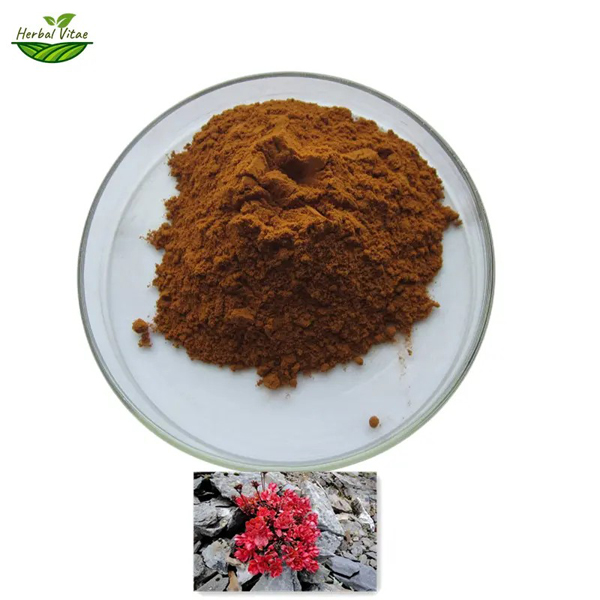
Herbal Vitae lists a reddish-brown Rhodiola rosea extract powder with salidroside and rosavin specifications. The stated levels and analytical definitions should be checked against the product's current technical documentation.
A product photograph illustrates the offered material but cannot independently establish botanical authenticity.
View Rhodiola Rosea Extract Powder SpecificationsRosavins vs Salidroside: Which Markers Help Identify Rhodiola Species?
Chemical markers are useful tools for botanical quality control. However, a marker that helps assess the composition of a product is not necessarily sufficient to confirm the complete botanical identity of that product.
1. Salidroside: Important, but Not Species-Specific
Salidroside is a phenylethanoid glycoside reported in multiple Rhodiola species, including R. rosea and R. crenulata. It is commonly used in chemical analysis and commercial extract specifications.
Because salidroside is not restricted to R. rosea, a certificate showing a high salidroside concentration cannot, by itself, demonstrate that a product was manufactured from authentic R. rosea roots or rhizomes.
2. Rosavins: Characteristic, but Not an Absolute Identity Test
The term total rosavins is commonly used for a group of phenylpropanoid glycosides that includes rosavin, rosarin and rosin. These compounds are important features of many established R. rosea reference profiles.
Individual phenylpropanoid glycoside
Related constituent in the marker group
Another constituent of the group
Although rosavin-related compounds have historically been used to distinguish R. rosea from other Rhodiola materials, research has also reported some of these compounds in additional species. Therefore, detecting a rosavin peak is not a substitute for a complete botanical identity assessment.
A more informative assessment examines the combined chemical pattern, relative marker concentrations, authenticated reference materials and available botanical traceability records.
What Does the USP Say About Rhodiola rosea?
The United States Pharmacopeia's Rhodiola rosea botanical material monograph identifies the species as dried roots and rhizomes. Its published definition includes minimum levels of phenylpropenoid glycosides, calculated as the sum of rosarin, rosavin and rosin, together with a separate minimum level for salidroside.
USP monograph reference: total rosavins
NLT 0.3%
For the defined dried botanical material
USP monograph reference: salidroside
NLT 0.08%
For the defined dried botanical material
NLT means "not less than." These values apply to the specific material defined in this USP monograph and should not automatically be applied to concentrated commercial extracts or interpreted as Herbal Vitae's current product assay results.
Reference: USP Rhodiola rosea Monograph . Buyers should consult the applicable current standard and full monograph when setting product acceptance criteria.
Why Rhodiola Species Substitution Is a Real Purchasing Risk
Rhodiola materials are sold as dried roots, powders, extracts and finished supplement ingredients. Processing can make botanical identification more difficult because the visual characteristics of the original plant are no longer available in the finished extract.
Commercial investigations have identified variation between labeled Rhodiola species and the chemical composition of some finished products. A study published in Phytomedicine examined commercial preparations and found that some products labeled as R. rosea lacked expected marker compounds or showed signs of possible substitution.
More recent analyses of commercial products have also identified discrepancies between declared and measured marker contents. These findings underline why a label claim should be verified rather than accepted as sufficient proof of identity.
Warning Signs That Deserve Further Investigation
A salidroside assay is not enough to establish that an ingredient contains authentic R. rosea.
The content of rosavin alone and the combined total of rosavin, rosarin and rosin are not necessarily the same result.
Analytical percentages should be accompanied by the relevant method, reporting basis and batch information.
The absence of source identification and lot records makes it harder to investigate possible species substitution.
These are screening signals rather than proof of adulteration. A definitive finding requires investigation using suitable methods and reference materials.
How Can Laboratories Authenticate Rhodiola Extracts?
No single procedure is suitable for every material type and every quality-control question. Raw botanical material can be examined using morphological or genetic methods, while processed extracts often require greater emphasis on chemical analysis.
HPLC and UPLC: Quantitative Marker Analysis
High-performance liquid chromatography (HPLC) and ultra-performance liquid chromatography (UPLC) can separate and quantify selected chemical compounds. When properly validated and performed with appropriate standards, these methods support the measurement of salidroside and rosavin-related markers. A chromatographic profile can provide additional information beyond one isolated assay value.
HPTLC: Chemical Fingerprint Comparison
High-performance thin-layer chromatography can be used to compare botanical fingerprints against authenticated reference materials. It is useful for screening chemical patterns and may help identify samples that warrant further laboratory investigation.
LC-MS and NMR: Additional Chemical Evidence
Liquid chromatography-mass spectrometry (LC-MS) and nuclear magnetic resonance (NMR) spectroscopy can provide complementary chemical information. Research has used these techniques to distinguish Rhodiola materials and investigate complex or questionable commercial samples.
Morphology and DNA: Raw Material Identification
Botanical examination and appropriate DNA-based methods may support species identification when suitable raw material or preserved samples are available. Their usefulness may be limited after extensive extraction and processing, especially when the relevant biological material has been degraded or removed.
Research reference: Authentication of Rhodiola Species Using NMR and HPLC .
A Practical Rhodiola Authentication Workflow
Confirm whether the material is specified as R. rosea, R. crenulata or another species. Check the actual raw material identity records.
Review salidroside and rosavin-related compounds together, using an appropriate method and authenticated comparison material.
If the chemical pattern conflicts with the label or reference material, consider confirmatory analysis and review the supply-chain records.
Confirm species identity, applicable assay limits, product composition, batch traceability and required quality documents before commercial approval.
How to Review a Rhodiola Extract COA Before Purchasing
A Certificate of Analysis (COA) should help the buyer determine whether the supplied batch meets the agreed specification. For Rhodiola extracts, the distinction between species identity and quantitative chemical assay results is particularly important.
| COA Review Item | What to Check |
|---|---|
| Botanical Species | Full scientific name and supporting identity records |
| Plant Part | Roots, rhizomes or the actual botanical parts used |
| Salidroside Assay | Measured percentage, method, reporting basis and acceptance limit |
| Rosavin / Total Rosavins | Clarify whether one compound or the combined marker group is being reported |
| Chemical Fingerprint | Whether suitable chromatographic identification or comparison data are available |
| Extract Composition | Extraction information, carrier ingredients and extract ratio where relevant |
| Batch Information | Lot number, test date, reference to the actual supplied material |
| Safety Requirements | Applicable microbiological, heavy metal, pesticide and residual solvent requirements |
Herbal Vitae's product listing describes salidroside concentrations of 1%–8% and a 3% rosavin specification. Buyers should confirm the exact currently available grades and whether the rosavin figure refers to the individual compound or a broader defined marker group.
General supplier documentation can be found in the Herbal Vitae document resources. A product-specific and batch-specific COA should be requested when required for purchasing approval.
Three Common Rhodiola Purchasing Scenarios
SCENARIO 01
The Specification Requires Rhodiola rosea
If the finished product specification explicitly requires R. rosea, the supplier must provide evidence supporting that species identity. A high salidroside result from an unspecified Rhodiola species is not an acceptable substitute for botanical authentication.
SCENARIO 02
The Buyer Receives an Unexpected Marker Profile
A sample labeled R. rosea may show salidroside but unexpectedly low or undetected rosavins. This is a reason to investigate botanical identity, extraction effects, analytical methods and possible substitution. It is not, by itself, conclusive proof of adulteration.
SCENARIO 03
Two Suppliers Offer Similar Salidroside Percentages
Similar salidroside values do not establish equivalence. Buyers should compare botanical species, marker definitions, extraction parameters, analytical confidence and application requirements before approving either material.
Rhodiola Ingredient Authentication Checklist
Before confirming a bulk Rhodiola extract order, ingredient buyers can use the following questions to structure their technical review.
Is the botanical material identified by its full scientific species name?
Is the plant part used for extraction documented?
Is salidroside tested together with appropriate additional identity markers?
Does the COA distinguish rosavin from total rosavins?
Are the analytical methods and reporting bases clearly stated?
Are raw material traceability and lot records available?
Does the material meet the required contaminant and quality specifications?
Can a representative sample be assessed before commercial approval?
Frequently Asked Questions About Rhodiola Rosea vs Rhodiola Crenulata
1. Are Rhodiola rosea and Rhodiola crenulata the same plant?
No. They are distinct botanical species within the same genus. Their chemical profiles and applicable material specifications are not identical.
2. Does salidroside prove that an extract is Rhodiola rosea?
No. Salidroside occurs in several Rhodiola species. Its presence can support chemical quality assessment, but it is insufficient as a stand-alone test for R. rosea identity.
3. Are rosavins exclusive to Rhodiola rosea?
Not absolutely. Rosavins are important characteristic markers in R. rosea analysis, but certain related compounds have been reported in other Rhodiola species. Their combined chemical pattern is more informative than a single marker peak.
4. Can Rhodiola crenulata replace Rhodiola rosea in a formulation?
Not automatically. If the formulation, purchase contract or regulatory specification requires R. rosea, substituting another species requires a separate technical and regulatory assessment.
5. Is 3% rosavin the same as 3% total rosavins?
No. Rosavin refers to an individual compound, while total rosavins generally describes the combined amount of specified related compounds. Buyers should confirm the precise definition used in the assay.
6. Can HPLC alone confirm the botanical species?
HPLC provides valuable chemical evidence, especially when multiple markers and authenticated references are used. However, species authentication may require additional botanical records or complementary analytical methods.
7. Why can two Rhodiola extracts have different chemical profiles?
Chemical profiles can differ due to botanical species, plant part, geographic origin, harvest conditions, extraction procedures and finished-product composition.
8. What documents should buyers request before approving Rhodiola extract?
Buyers should request an appropriate product specification, relevant identity documentation, marker assay data, batch COA and applicable safety testing records. Additional botanical authentication evidence may be necessary depending on the project.
Conclusion: Botanical Identity Matters More Than a Single Marker Percentage
The distinction between Rhodiola rosea and Rhodiola crenulata is not merely a matter of botanical naming. It affects raw material selection, chemical characterization, analytical quality control and compliance with an agreed product specification.
Salidroside and rosavins are important analytical tools, but neither should be treated as a complete substitute for species authentication. The most reliable purchasing decisions combine botanical identity records, suitable chemical testing, supplier documentation and batch-specific quality verification.
For ingredient buyers, the objective is not simply to purchase the extract with the highest advertised marker content. It is to obtain material that matches the intended botanical species, analytical definition and application requirements.
Scientific References & Further Reading
United States Pharmacopeia. Rhodiola rosea botanical material monograph. View USP reference.
Booker et al. The authenticity and quality of Rhodiola rosea products. Phytomedicine, 2016. View research.
Authenticity and quality evaluation of different Rhodiola species and commercial products based on NMR-spectroscopy and HPLC. 2020. View research.
Adulteration prevention-oriented systematic review of chemical constituents in the genus Rhodiola. Frontiers in Pharmacology, 2026. View research.
The quality and safety of Rhodiola rosea supplements on the U.S. market: An analysis of biomarkers, heavy metals, and pesticide residues. PLOS ONE, 2026. View research.
Looking for Rhodiola Rosea Extract Powder?
Herbal Vitae lists Rhodiola Rosea Extract Powder for bulk botanical ingredient purchasing. Buyers can review the available product information and discuss the species identity, assay specifications and documents required for their sourcing project.
View our Rhodiola Rosea Extract Powder product page or contact Herbal Vitae to request current product details and a quotation.
Discuss Rhodiola Extract Requirements